Shipley research puts it plainly: in 40 to 60% of federal pursuits, the customer already has a preferred vendor before the RFP drops.
That preference gets built during capture, through whitepapers, customer calls, and positioning work done months before Sections L and M ever exist. Which raises a practical question every BD and capture team faces: how do you write a whitepaper for a government customer, plus the capture strategy document, ghosting statements, and win theme drafts behind it, when your capture managers are already juggling five pursuits?
pWin.ai Chat was built for exactly this stage of the BD lifecycle. It drafts capture artifacts that are grounded in the specific opportunity you’re working: the agency, the requirements, the incumbent, the pain points, and everything your team has gathered in the Capture Vault and Knowledge Repository.
Why Capture Artifacts Decide Wins Before the RFP Drops
Capture is where PWin, your probability of win, actually moves. By the time the solicitation hits SAM.gov, the customer’s requirements are shaped, the competitive field is set, and evaluators have impressions of who can do the work. The artifacts that shape those impressions are well known to anyone running a Shipley-style capture effort:
- Capture strategy documents that lay out the customer’s hot buttons, the competitive assessment, and your path to win
- Whitepapers that educate the customer on your solution and influence requirements pre-solicitation
- Ghosting statements that highlight a competitor’s weaknesses or neutralize their strengths without naming them
- Win theme drafts that connect customer pain points to your discriminators, with proof
- Call plans for structuring customer engagement ahead of bid decisions
- Capability statements tailored to the agency and the scope
The problem is time. Most capture teams know these artifacts raise PWin. They skip them anyway because drafting each one from scratch takes days they don’t have.
What Makes pWin.ai Chat Different from Generic AI Tools?
Generic AI chat tools start every conversation knowing nothing about your pursuit. You paste in context, prompt, re-paste, and re-prompt, and the output still reads like it was written by someone who has never met your customer.
pWin.ai Chat starts with the full picture already loaded. Inside an Opportunity Project, Chat has direct access to your opportunity details, Capture Vault documents, capture notes, the generated Capture Plan, and your connected Knowledge Repository sources. You can narrow the context further by Shared KR, document type, or client. Every response comes with citations that trace claims back to source documents, so you can verify before anything goes in front of a customer.
That context is what separates a usable artifact from a generic one. A ghosting statement only works if it reflects the actual competitive field. A win theme only lands if it ties a real customer pain point to a discriminator you can prove. Chat drafts from what your team actually knows about the pursuit.
How to Write a Whitepaper with pWin.ai Chat
Take the whitepaper, the workhorse of pre-RFP positioning. Here’s what the workflow looks like in practice:
- Start inside the Opportunity Project. Chat already knows the agency, the anticipated scope, and everything in your Capture Vault, so there’s no context-dumping step.
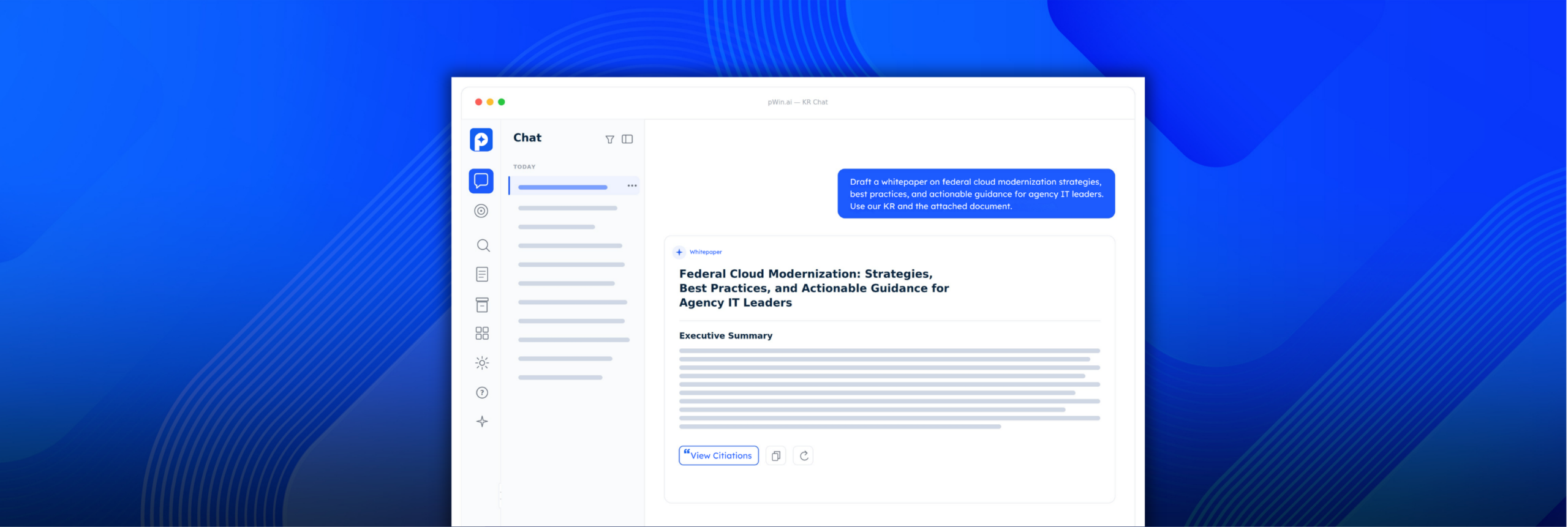
- Ask for the draft. Prompt Chat to draft a white paper addressing the customer’s problem, or use a template from your Shared Prompt Library for a structured starting point.
- Shape the argument. Ask Chat to pull customer pain points from your capture notes, extract proof points from past performance in your KR, and thread your win themes through the narrative.
- Check the citations. Every claim traces back to a source document, so you know the technical assertions and past performance references hold up.
- Download as a formatted Word document. The draft is ready for SME review and delivery to your customer contact.
What used to consume a week of a capture manager’s time, or sit undone entirely, becomes an afternoon of review and refinement.
Matthew Martin, VP of Technology & Security at Disruptive Solutions, describes the shift: “The Chat feature has replaced a lot of my ad-hoc ChatGPT queries and the tool now shapes our capture strategy, guides teaming conversations, and surfaces gaps in our content repository that influence which solicitations we pursue.”
One Thread from Capture to Proposal
Because these artifacts live inside pWin.ai, nothing gets lost at proposal handoff. The win themes, pain points, and competitor positioning you develop through Chat carry into the Content Plan when the opportunity links to a proposal project, so your proposal team inherits the capture thinking instead of reconstructing it.
Conclusion
The pursuits you win are usually the ones you shaped early. pWin.ai Chat removes the main reason capture artifacts go unwritten: the time it takes to draft them. Your team brings the customer knowledge and the strategy; Chat turns it into whitepapers, ghosting statements, win themes, and capture documents grounded in the real opportunity.
If you would like to see how pWin.ai Chat can put high-quality capture artifacts within reach on every pursuit, request a demo at pwin.ai.
References: Shipley Capture Planning