Built for High-Stakes Government Bids
Unify knowledge management, opportunity intelligence, capture planning, and proposal writing in one powerful platform for your entire growth team – BD, capture and proposal.
Organizations Trust pWin.ai








Powerful Capture and Proposal Features That Adapt to Your Team

Strategy-Led Proposal Intelligence
Your team sets the evaluation factor, customer priority, win theme, discriminator, solution approach, evidence, and writing direction before drafting starts. The Content Plan is a management and approval artifact, not an AI input form.

Workflow
Adaptability
Generate quick responses and collateral like whitpapers, get answers to questions, and pull proof points in a matter of minutes. Or run the full workflow from Content Plan to submission. Both draw on the same governed repository and the same citations.

Verified Content
Generation
The Knowledge Repository discovers, composes, and traces evidence against the opportunity in front of you. Generated content carries source references, down to document and page, and treats compliance with solicitation requirements as a top priority.

Shipley-Informed
Craft
Fifty years of proposal methodology, built into the writing software. Best practices in capture and proposal strategy flow into generated drafts, with the option to follow official Shipley templates.

Safe-to-Submit
AI
Independently assessed FedRAMP Moderate Equivalency, CMMC Level 2 aligned, cleared for CUI. Every section is grounded, cited, reviewable, and governed by human judgment.

Compliance is the floor. Credibility is the ceiling.
See how the Content Plan, the Knowledge Repository, and the review reports work on a live bid.
Time Reduction to First Draft
Avg. Win Rate Increase
Hours Saved per Proposal
One Connected Workflow, From Capture Intelligence to Submission
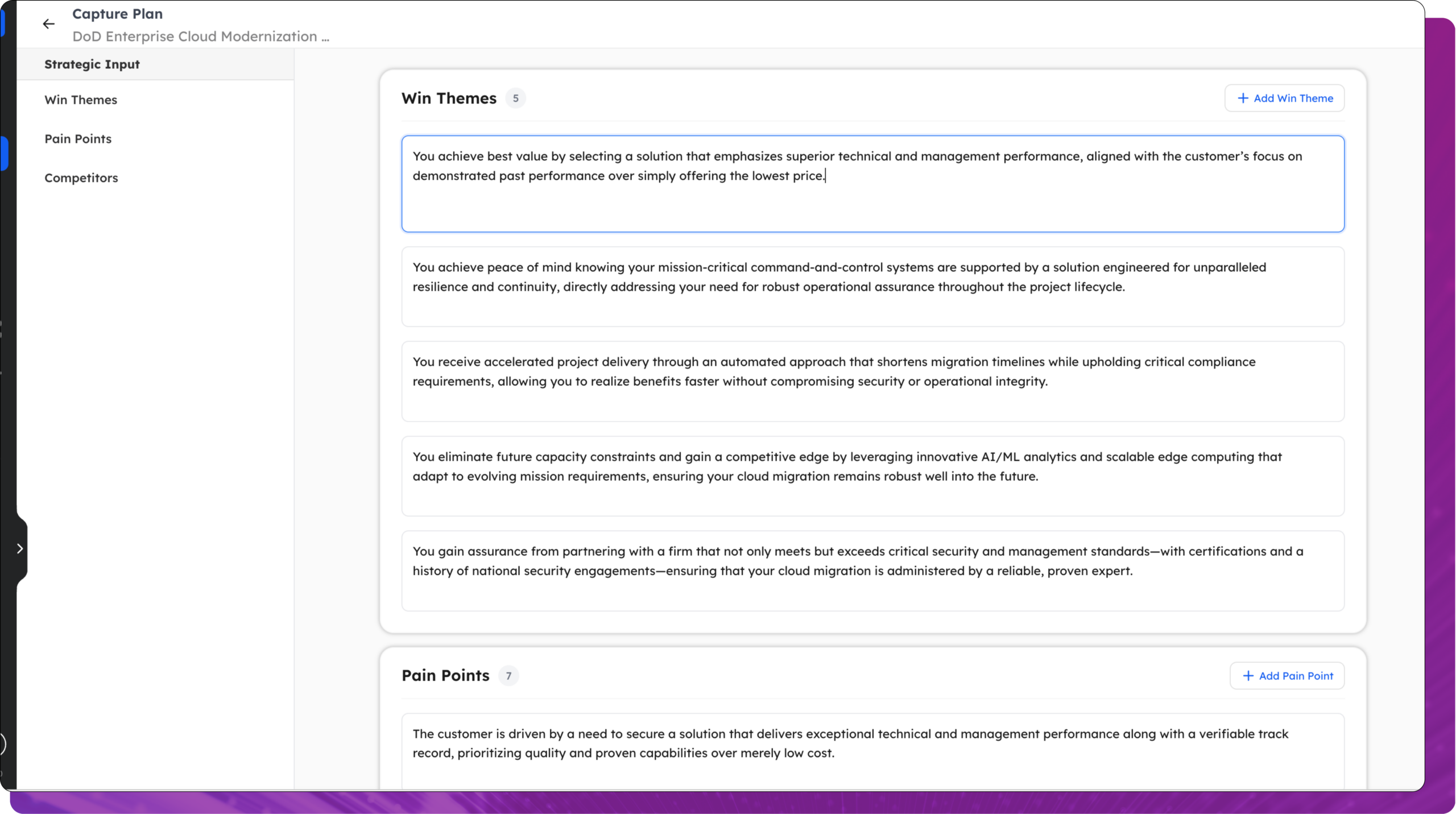
Customer Insight Should Not Disappear at the Handoff
The Capture Plan holds win themes, hot buttons, pain points, discriminators, and competitor intelligence in one place, then moves them into the Content Plan, the annotated outline, and the draft. TechnoMile and your CRM feed opportunity intelligence in at the top.
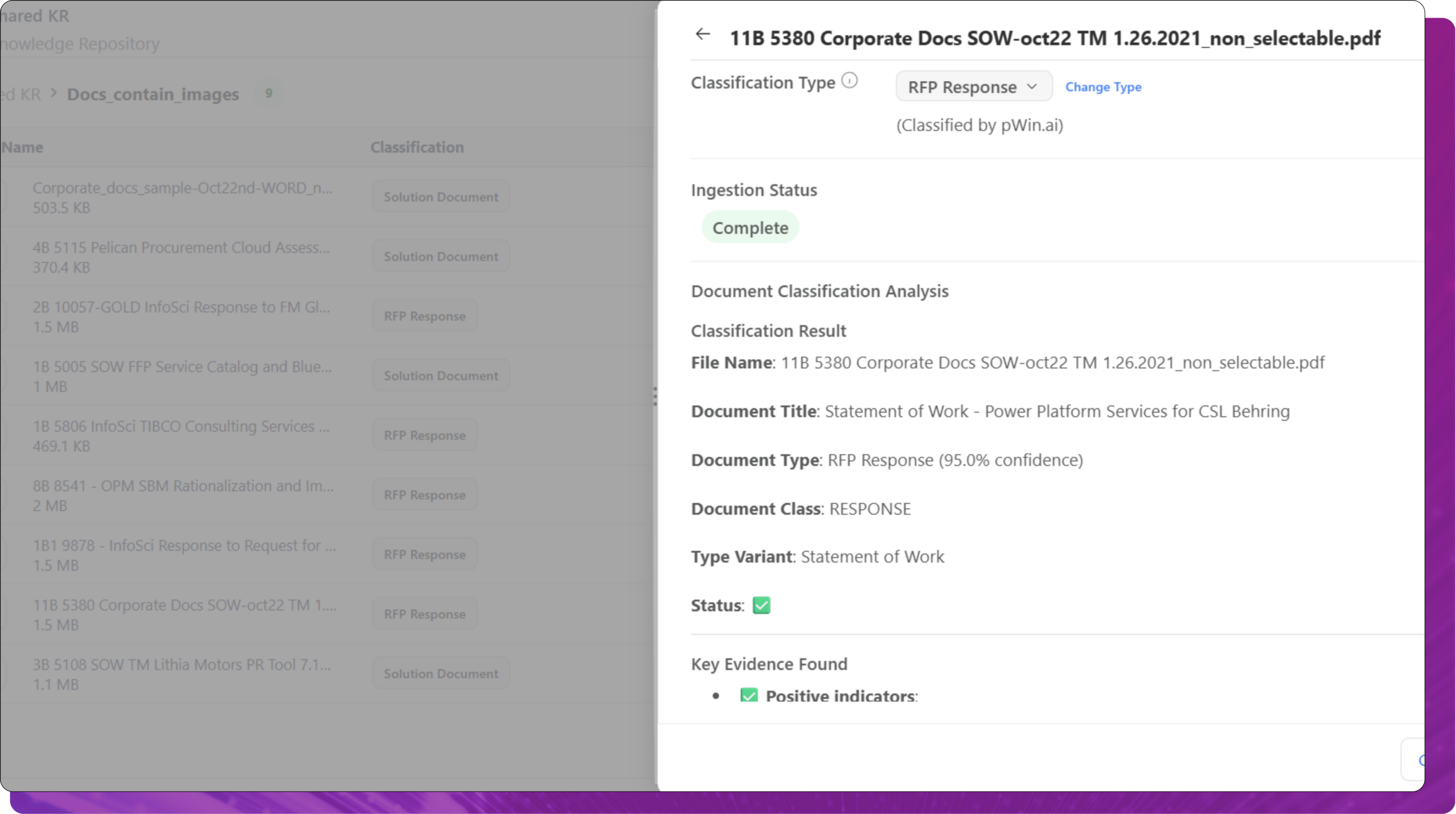
Scattered Knowledge, Turned Into Opportunity-Specific Evidence
Past proposals, CPARS, monthly reports, resumes, and capabilities content are indexed and retrieved in the context of the bid in front of you, then composed into customer-facing proof points instead of pasted boilerplate.
- Retrieval into whitepapers, solution points, and Chat answers
- Discover, qualify, compose, trace — four stages behind every proof point
- Proof points tied to requirements, evaluation factors, and win themes
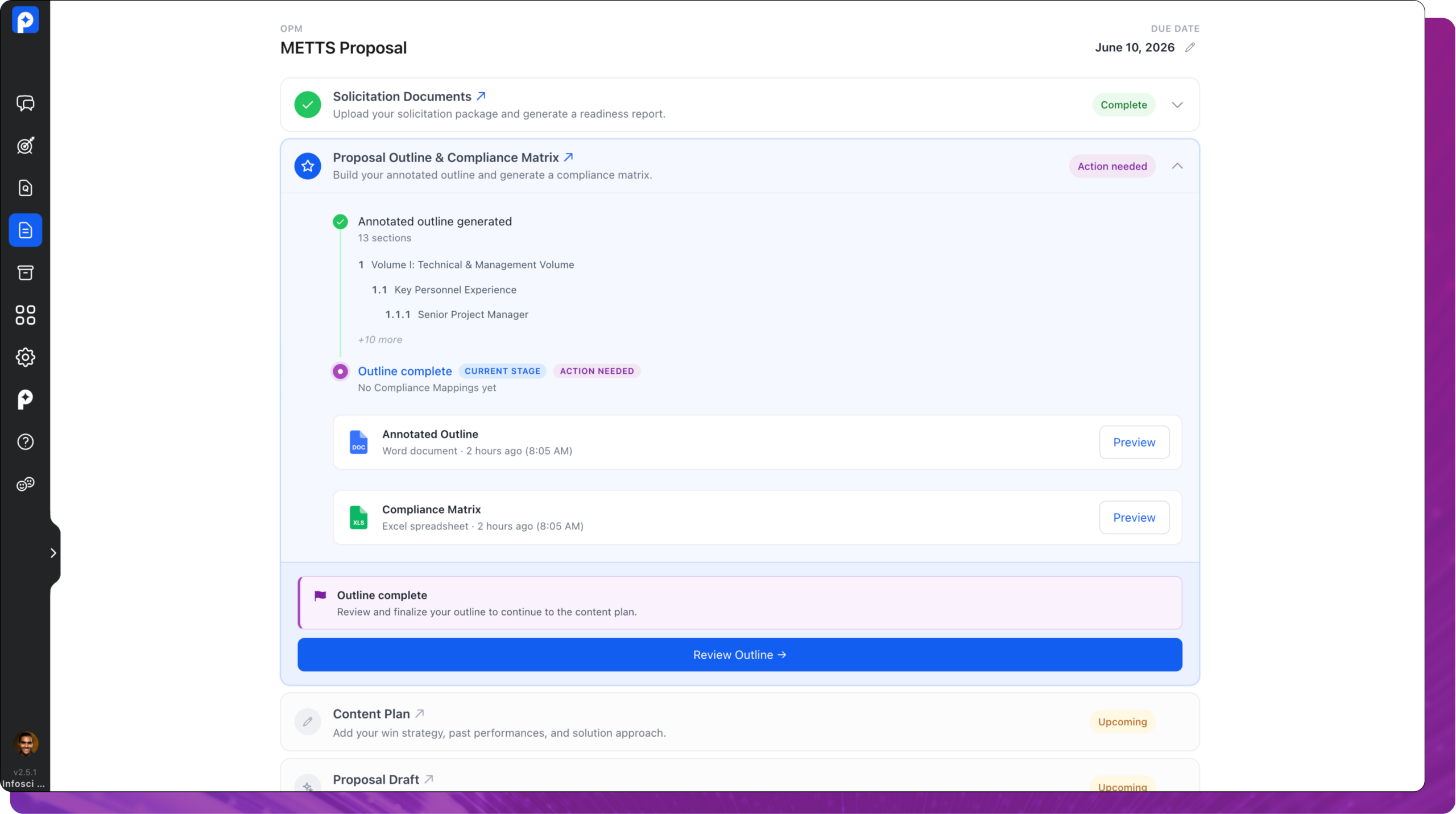
We Write for Evaluators, Not Word Counts
The Annotated Outline Builder maps each requirement to a planned section, drawing evaluation factors out of Sections L, M, and C. Multi-pass drafting then writes against the approved Content Plan and regenerates the affected sections when your strategy changes.
- Microsoft Word Add-in surfacing the source KR document on every citation
- Human decision gates at win strategy, discriminators, solution approach, section intent, and final text
- Compliance, Citation, Hallucination, and Shipley Strategy reports at every color team
- Core, Expanded, or bring-your-own outline starting points
A Two-Minute Answer Held to the Same Standard as the Volume You Submit
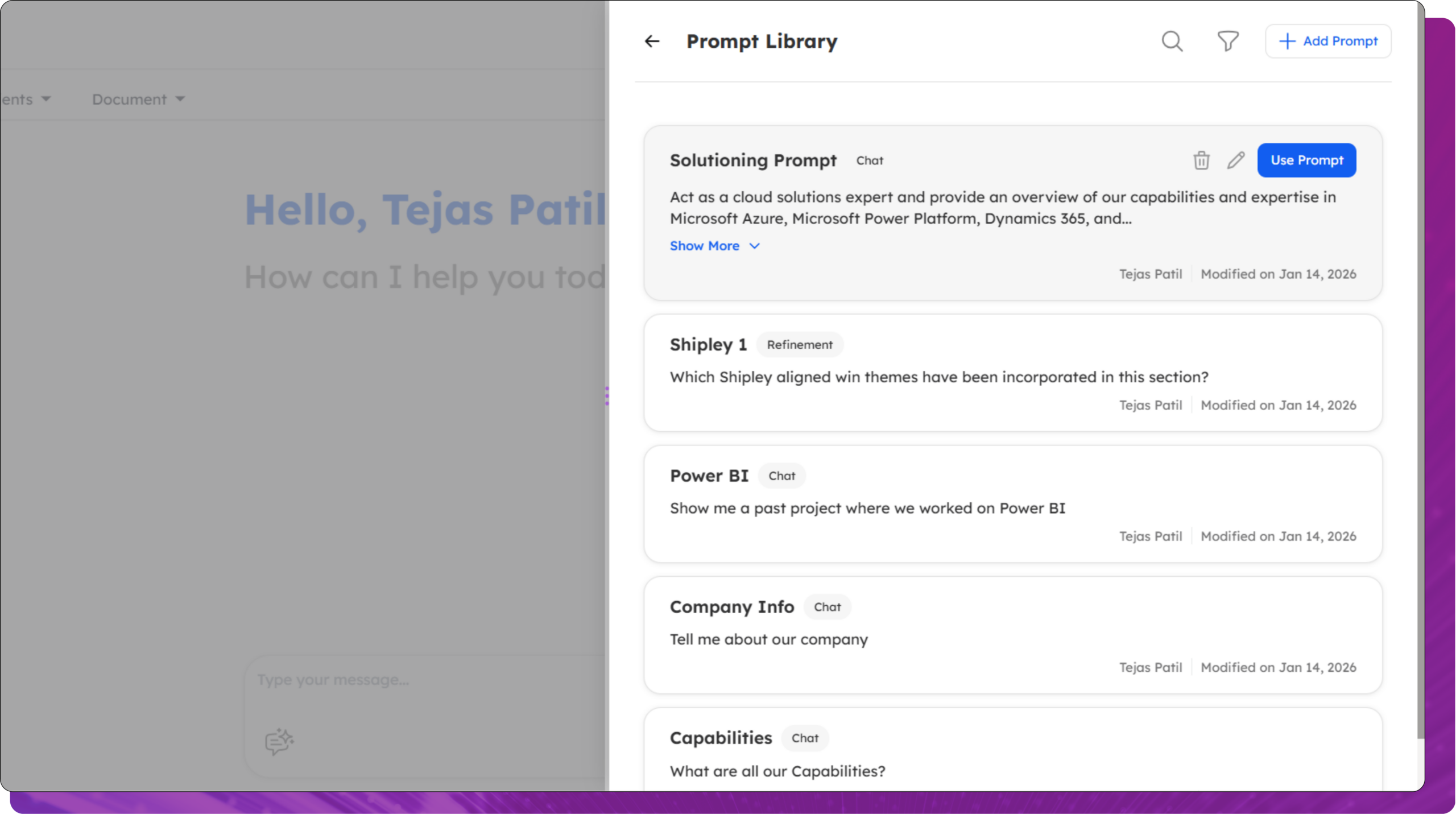
On the light end, your team talks to its own content: ask the Knowledge Repository a question, summarize a solicitation, pull proof points, or generate a whitepaper, capture brief, or orals prep package from a prompt template. Everything downloads as a formatted Word document, with citations intact.
- RFI Accelerator for shorter-form responses, cited to your own content
- Chat standalone, inside an Opportunity Project, or beside the Annotated Outline Builder
- Shared Prompt Library for capture briefs, orals prep, and Go/No-Go assessments
GovCons Win More with pWin.ai
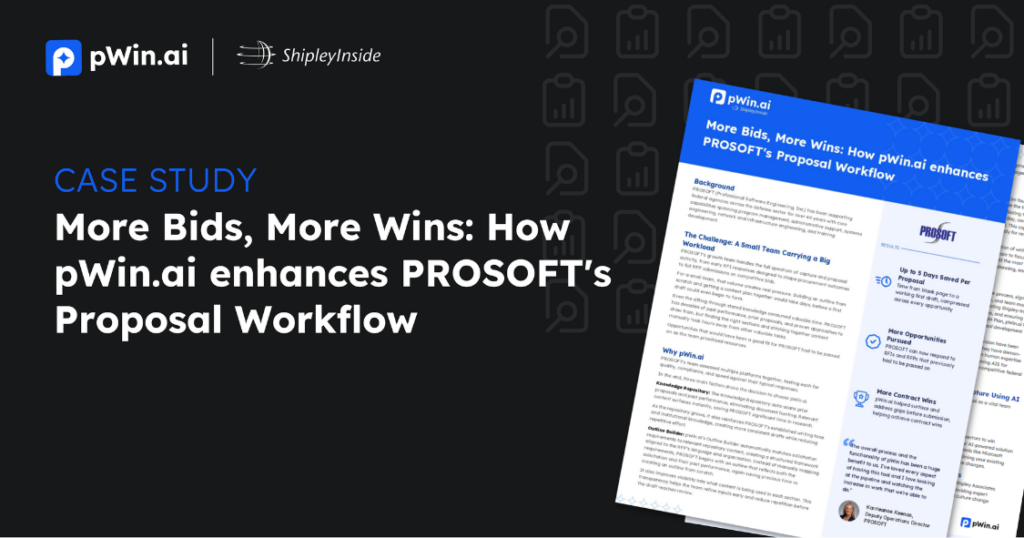
PROSOFT Saves 5 Days per Competitive Bid
Case Study
Learn how PROSOFT transformed its federal capture and proposal process with pWin.ai, cutting up to five days from draft development and accelerating time to submission.
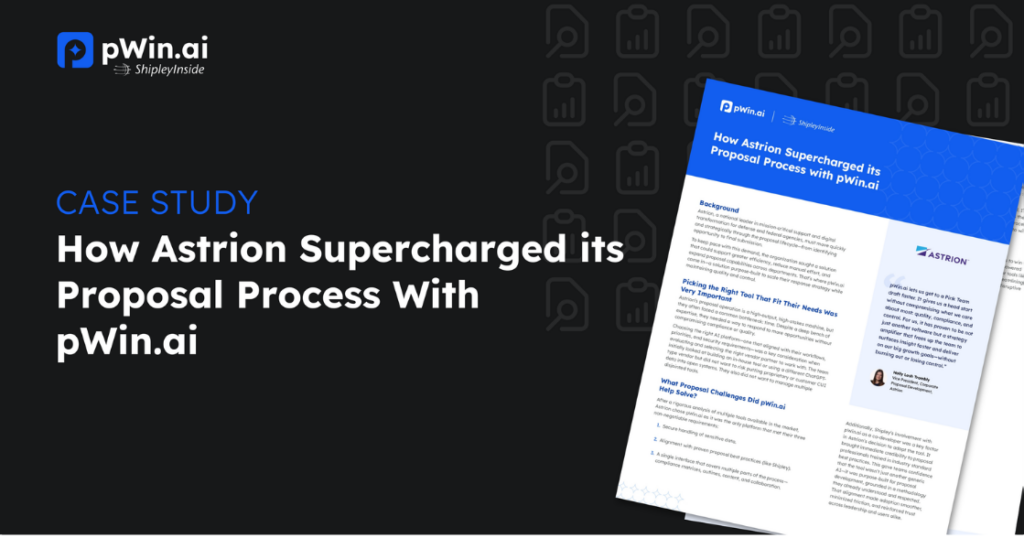
Astrion Boosts its Business Development and Capture Process
Case Study
pWin.ai isn’t just a software tool, but a strategy amplifier for Astrion. It streamlines proposal development, scales BD efforts, and empowers teams to focus on winning work.

Top Aerospace GovCon Saves 1,000 Hrs per Bid
Case Study
A top 10 U.S. Aerospace Manufacturer integrated pWin.ai into its proposal operations and saw up to 90% efficiency gains when deployed to 60+ users across 4 business units.
Empower Your Team with pWin.aiTM

For Growth Leaders
Raise win rates, improve efficiency, and scale proposal operations while controlling cost.

For Proposal Managers
Meet deadlines, stay compliant, and win more bids without overburdening their teams.

For Proposal Directors
Boost team efficiency, enforce best practices, and win more with Shipley-backed automation.

For Security Teams
Bid securely with FedRAMP Moderate equivalence, assessed by independent 3PAO.
What Our Customers Say About Us

“The overall process and the functionality of pWin have been a huge benefit to us. I’ve loved every aspect of having this tool and I love looking at the pipeline and watching the increase in work that we’re able to do.”

“I’ve written a lot of proposals over the years, and pWin.ai definitely makes it a lot easier. It gets you going, gives you something to look at, and allows you to start thinking through the draft earlier. It is going to be transformative in our organization.”

“I had very high standards, being a proposal professional myself, so I came up with a requirements matrix of the vision of what I wanted this to be able to do for my team. Meeting with the pWin.ai execs, I felt heard and part of a true partnership, and I knew I wanted that same experience I have with Shipley.”

“pWin.ai has become a third arm for us because we can turn it loose, and it will create something we can take right off the press and then work on. It gives us the ability to use our folks in other parts of the job that make more sense for response generation. Initial drafts are generated quickly and efficiently by utilizing pWin.ai early in the response process, sometimes even before the RFP land.”

“pWin.ai has helped us turn more than one no-bid into a bid. A recent RFP with a two-week turnaround is a perfect example. Without pWin.ai, the time required to produce a first draft would have been too long for our team to manage alongside their other priorities. With pWin.ai, we quickly generate a quality first draft, giving our team the time and space to refine and submit a strong final proposal. Thanks to pWin.ai, we’re now able to take more shots on goal.”
